Recognizing the era of a Gucci piece solely from its label is one of the most beloved (and frustrating) exercises for vintage fashion collectors. Gucci labels have changed many times over the decades, following the evolution of the logo, materials, and textile labeling regulations. Learning to read them is the first step to correctly dating a piece, distinguishing a truly vintage item from a modern re-edition, and, in general, better understanding what you have in your hands.
In this guide, we will see how the Gucci label has changed over time, which elements to observe, and what to pay attention to when analyzing a garment, a bag, or an accessory.
A bit of history: from luggage to fashion giant
To understand the labels, one must first understand the history of the brand. Gucci was born in Florence in 1921, founded by Guccio Gucci, who was inspired by the elegant luggage he saw during his years working in a London hotel. The company started as a leather goods and travel accessories workshop, before rapidly expanding into shoes, bags, and, later, clothing.
Each stage of the brand's growth has left a different imprint on the labels, and it is precisely this evolution that provides us with the most useful clues for dating.
Label elements to observe
When examining a Gucci label to understand which era it comes from, there are several key elements to focus on:
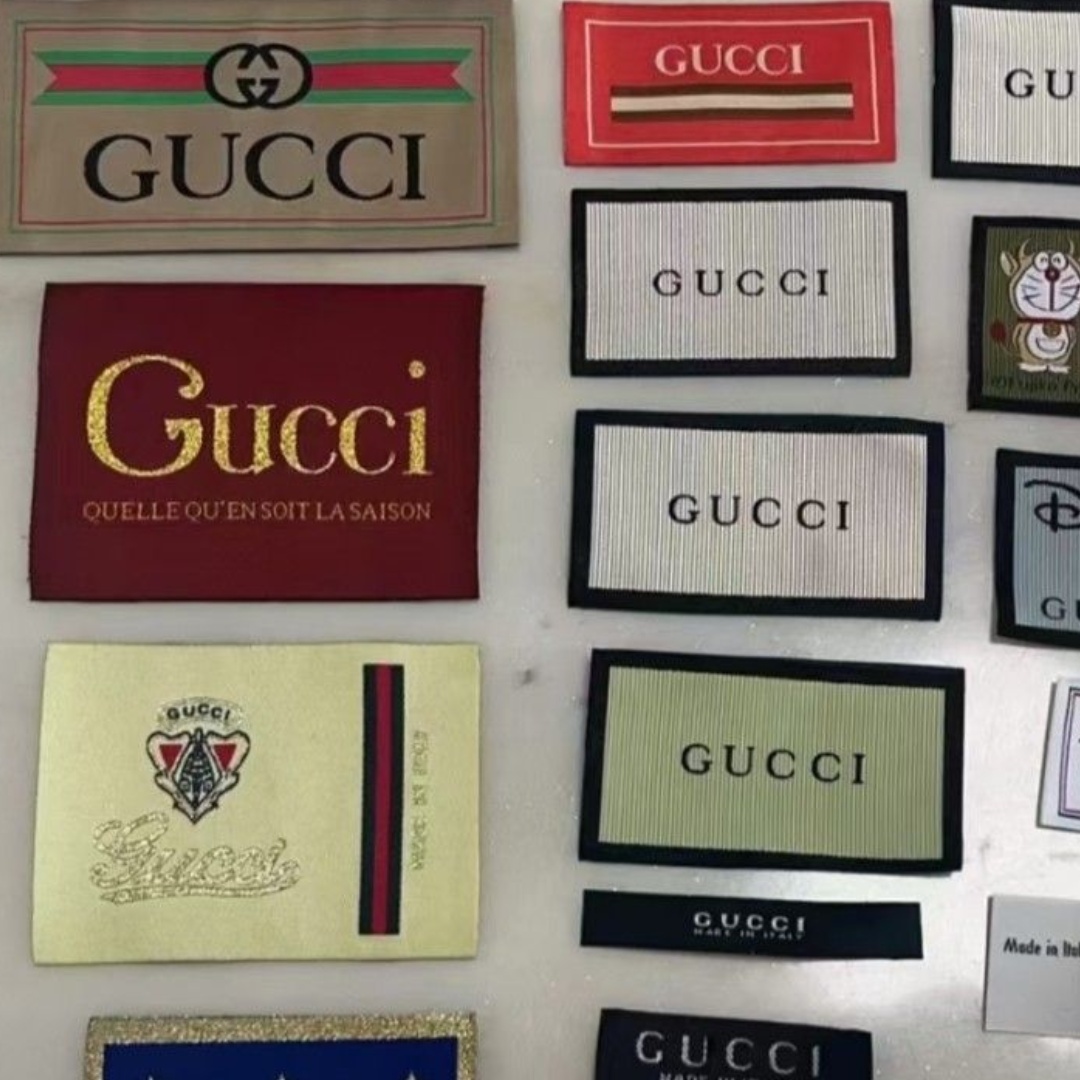
The logo and its graphics. The Gucci logo has undergone several variations over the decades: from the original monogram with the writing “Valigeria G. Gucci Firenze” from the early years, through the versions featuring the “liftboy” figure (the hotel bellboy, a symbol of the brand's origins), to the interlocking double G we know today. The font style, the angle of the letters, and the presence or absence of certain graphic elements are precious clues.
The colors used. The first labels were generally monochromatic. The introduction of color, particularly red, is a detail that begins to appear from a certain period and can help narrow down the timeframe.
Composition and care information. Modern labels include material indications and washing instructions, elements that are almost always missing from older pieces, when this type of information was not yet a required standard.
The “Made in Italy” wording. Gucci has always maintained a strong Italian production imprint, so it is normal to find this indication on most pieces, regardless of the period. However, the graphics and the positioning of this text can vary.
Shape and material of the label. Even the physical shape of the label has changed: from simpler rectangles to different shapes, with materials and colors (white, yellow) that have alternated over time.
Labels on bags and leather accessories: the serial number
For bags and leather accessories, in addition to the logo label, it is essential to observe the serial number, often also called the “date code”.
On many bags produced after the '90s, the serial number is generally found on a rectangular leather label sewn inside the bag, usually at the top near the lining, and features two rows of numbers: the first row indicates the model, the second refers to the production batch.
It is important to know that, unlike other brands, the Gucci serial number does not directly indicate the exact year of production, but is rather an internal identification code.
For more recent bags, produced after 2014, a black fabric label with a QR code has appeared, designed specifically to combat counterfeiting and to allow verification via the official app.
A summary by decade
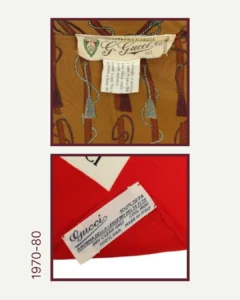
1970-80. The Gucci logo is written in italics and, in some cases, features the emblem symbolizing the maison, depicting the “liftboy”.
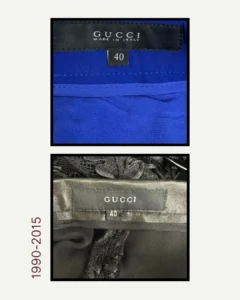
1990-2015. In the period between the late '90s and early '00s, Tom Ford introduced the minimal black label with white lettering. In the years following Ford's creative direction, the “Made in Italy” wording was added.
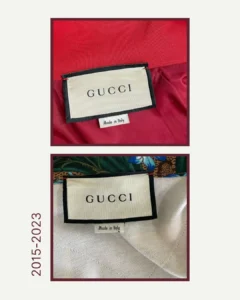
2015-2023. Alessandro Michele, leading the brand during this period, introduced a new label. It is larger, in cream-colored grosgrain with a black border. The “Gucci” logo is in the center of the label, and at the bottom, there is another smaller label bearing the “Made in Italy” wording.
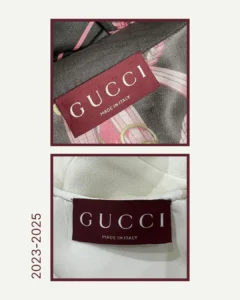
2023-2025. Creative Director Sabato De Sarno presented the new Gucci brand identity, centered on burgundy. Consequently, garment labels also take on a new aesthetic: they are simple burgundy rectangles, with the lettering positioned in the center, in white and larger, and “Made in Italy” below in small print.
Dating a Gucci piece through its label requires some practice, but it becomes easier once you know the main reference points: logo evolution, colors, the presence of material information, and serial numbers. None of these elements, on its own, is definitive proof, but together they allow you to significantly narrow down the production period of a garment or accessory, making the search for vintage Gucci even more exciting.
Discover our Gucci selection online and in our boutiques in Milan, Brera, Como, and Legnano.