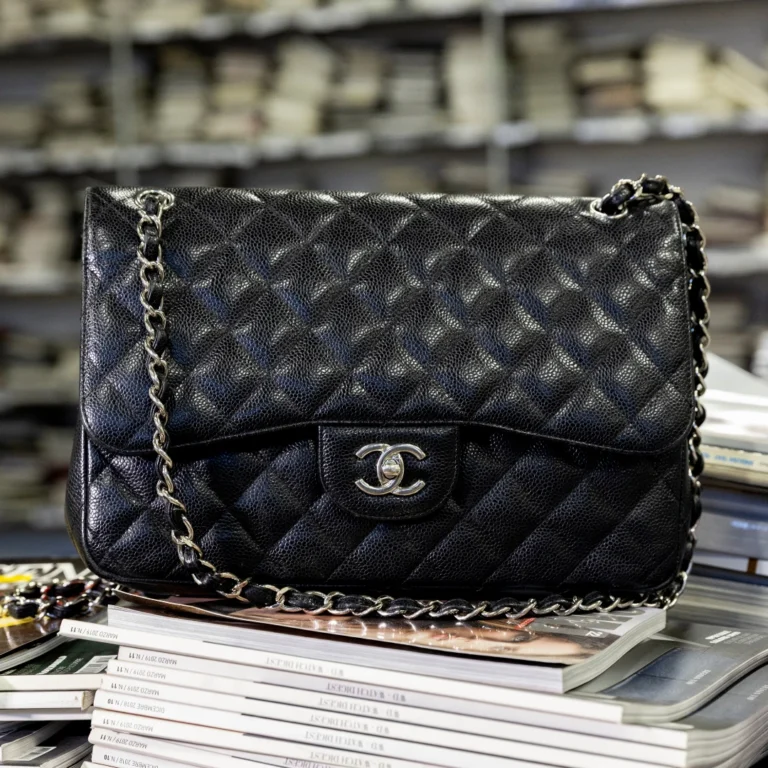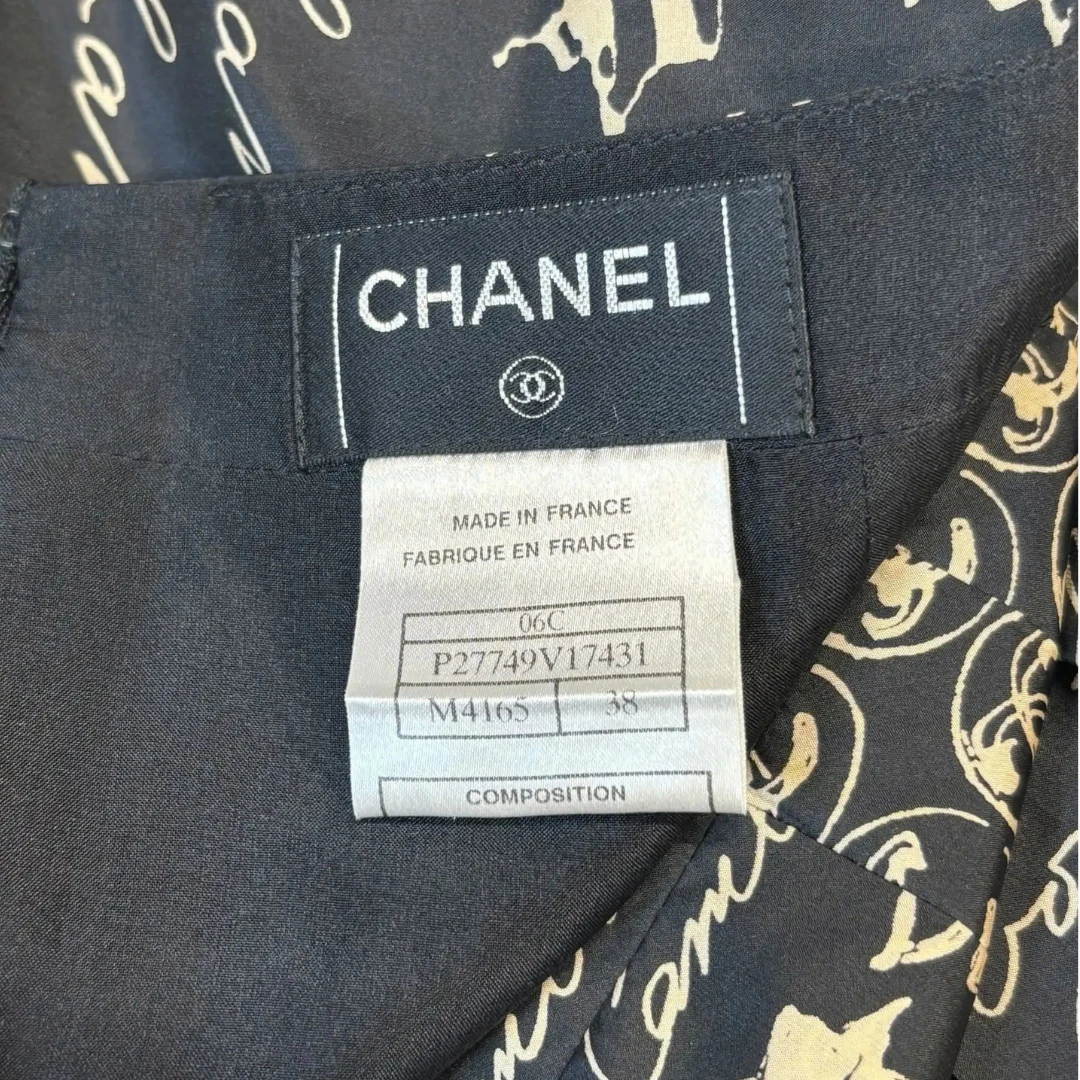
Every Chanel piece holds a little secret, sewn just a few centimeters from the heart: the label. Even before touching the tweed or admiring the double C buttons, it is there that you read the history of a piece, the season it was born in, and the collection it walked for.
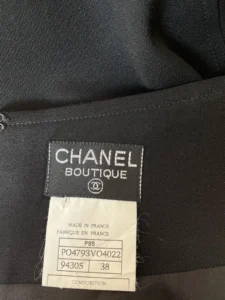
For those who love vintage fashion, knowing how to read a Chanel label is the first step to recognizing a true treasure. Until around 2010, every piece featured the production year and the corresponding collection: two digits for the year, followed (or preceded) by a letter indicating the season. Below, a series of internal codes indicates the style and color, and finally, the size.
A coded language, certainly, but once deciphered, it allows you to date a vintage Chanel piece, understand which collection it comes from, and better assess its value. In this guide, we explain how to read every line of the label, with examples we encounter every day among the dresses, suits, and accessories in our luxury vintage fashion selection.
What is written on a vintage Chanel label
On the labels of Chanel pieces produced before 2010, you will generally find four pieces of information:
- the seasonal code: two digits for the year and one letter for the collection (for example, 98A);
- the style code, an internal sequence for the maison;
- the color code, which is also numerical and internal;
- the size, usually in French sizing (FR 36, 38, 40, etc.).
The first code is the one that interests collectors and resellers the most: on its own, it tells you when and for which season the piece was created. The others are production codes, designed for the company's internal management rather than for the customer. They are primarily used to precisely identify the model and colorway, for instance when searching for an identical piece or comparing a garment to runway images.
How to read the year and collection: the seasonal code
The seasonal code consists of three characters. The first two digits are the last two of the production year: 96 stands for 1996, 04 for 2004. The final letter indicates the collection.
| Letter | Meaning |
|---|---|
| P | Printemps, spring/summer collection |
| A | Automne, autumn/winter collection |
| C | Cruise, the resort collection |
| T | Most likely Transition, a transition collection (see below) |
Let's look at some examples:
- 98A is a piece from the autumn/winter 1998 collection.
- 03P is from the spring/summer 2003 collection.
- 05C belongs to the Cruise 2005 collection.
A detail that makes a difference when dating a piece: the indicated year is that of the collection, not necessarily the year the garment was first purchased or worn. An autumn/winter 1998 collection coat, for example, arrived in boutiques during that year.
The mystery of T: what does 00T mean
If you browse through pieces from the 2000s, you will come across labels with the notation 00T. The letter T is not part of the classic P, A, C scheme and deserves a special note.
Chanel has never published an official legend for its codes, so everything we know comes from the experience of collectors, resellers, and vintage experts. The sources we have consulted indicate T as an abbreviation for Transition: a transition collection that sits between two main seasons. This interpretation is consistent with what is observed on Chanel jewelry from that era, where T appears alongside P, A, and C. For clothing, however, there is no official confirmation, which is why we consider it the most plausible interpretation, rather than a certainty.
Our advice, if you find an 00T piece: use the code to date the piece to 2000 and, to understand which collection it belongs to, compare it with runway images and archives from that period.
The numbers below: style and color codes
Below the seasonal code, one or more numerical sequences appear. These are internal maison codes that identify the style and color of the piece. They are not read like the year: they do not hide a date, but function as an address to find that specific model in the company's archives.
They are useful in three cases:
- to compare two pieces of the same model in different colors;
- to search for an identical piece from other retailers or at auctions;
- to verify the consistency between the label and the garment in front of you.
A practical tip: always photograph the entire label and keep the codes. If one day you want to resell the piece, or simply find another similar one, they will be your starting point.
The size on the Chanel label
At the bottom of the label, you will find the size, almost always expressed in French sizing. As a general rule, an FR 38 corresponds to an Italian 42 and an FR 40 to a 44, but it is always best to check the actual measurements of the garment, as vintage models have very different fits compared to today's standards. For accessories, the notation may differ: you may come across acronyms like NSZ, which indicate the absence of a size.
And after 2010? The labels change
The closer we get to the present day, the more complex the system becomes. In recent collections, Chanel uses a greater number of codes for different seasons, and some letters have changed meaning compared to the past. The A, which on vintage pieces indicates autumn, is associated with Métiers d’Art or pre-fall collections on more recent labels, while autumn/winter is divided into two periods, indicated by other letters. For this reason, it is important to read each label within the context of its period: the same code can mean different things depending on the era.
Is the label enough to recognize an authentic Chanel?
No. The label is a precious clue, but not proof of authenticity. A label can be resewn, copied, or moved from one garment to another. To evaluate a Chanel piece, you need to look at the whole:
- the quality of the fabric and the internal finishes;
- the stitching and the alignment of the patterns, especially in tweeds;
- the buttons, their engravings, and how they are attached;
- the weight of the chain in the hem of jackets and suits;
- the consistency between the year, collection, and style of the garment.
If you are considering purchasing a high-value piece, rely on a retailer that checks every detail, and be wary of prices that are too low to be true.
Discover vintage Chanel pieces at La Belle Époque
Reading a Chanel label is a bit like learning a language: at first it seems like a puzzle, then it becomes a pleasure. At La Belle Époque, we carefully select every piece and check its details one by one, because those who choose luxury vintage deserve to know exactly what they are wearing.
You can discover our Chanel pieces and other designers from our selection online at labelleepoqueboutique.com, or come and visit us in our boutiques in Milano, Como, and Legnano.