There are luxury brands that inhabit the present, and then there is Prada: a brand that seems to exist in a time dimension of its own, capable of engaging with the past, the future, and the intellect in a single, unmistakable stylistic gesture. It is not merely fashion; it is a system of thought. And perhaps that is exactly why a Prada piece purchased twenty years ago, or found today in a niche vintage market, still possesses all its strength.
In this article, we trace the history of one of the most influential fashion houses in the world: from its bourgeois Milanese origins to its global phenomenon status, through the intellectual revolution of Miuccia Prada and the material innovations that forever changed the concept of elegance. We also explain why, today, choosing vintage and pre-owned Prada is not just a sustainable gesture, but an act of conscious style.
Milan, 1913. A legend is born
It all begins in Galleria Vittorio Emanuele II, in the heart of Milan. In 1913, Mario Prada opens a small leather goods shop destined for the aristocracy and the upper bourgeoisie: travel bags, wallets, trunks, and leather accessories of the highest craftsmanship, created by artisans selected with manic care. The shop is called Fratelli Prada, and almost immediately obtains the patent as an official supplier to the Italian Royal House.
In those years, buying from Prada meant belonging to a certain world: cultured, refined, and resistant to ephemeral trends. A philosophy that would survive decades, transformations, and cultural revolutions, remaining the invisible thread running through everything the brand would produce from that moment on.
«Fashion is made of dreams, but lasting dreams are made of quality.»
Mario Prada
For over sixty years, the maison remains a respected institution, yet limited to a Milanese and Italian clientele. These are the years of artisanal solidity, of a reputation built piece by piece. Then, in the second half of the twentieth century, Luisa Prada, granddaughter of the founder Mario, arrives to lead the company with a firm hand for twenty years. And finally, in 1978, the person who would change everything enters the scene.
The rise of Miuccia: when fashion becomes philosophy
Miuccia Prada was not supposed to be a designer. A graduate in Political Science from the University of Milan and a student of the Piccolo Teatro, she has the curriculum of a militant intellectual, not the heir to a luxury maison. When she took the reins of the company in 1978 alongside her husband and partner Patrizio Bertelli, the industry did not yet know what to expect from her. And she would not disappoint them, but not in the way they expected.
Miuccia does not make fashion for pleasure. She makes it to question, to disturb, to reason aloud through fabrics. Each collection is a visual essay on subjects ranging from feminism to power, from social class to eroticism, from nostalgia to the future. She has transformed the runway into a place of critical thought, and the garment into an object capable of containing contradictions.
Her first revolutionary move arrives almost immediately: in 1984, she launches the black nylon bag with the enameled triangle logo. An industrial, functional, almost brutal material, elevated to a symbol of minimalist luxury. The market remains disoriented. Then, it understands. That bag and its variations, its evolutions, would become one of the most desired and imitated accessories in the history of contemporary fashion.
Prada in the fashion pantheon: an influence impossible to measure
There are brands that follow culture and brands that create it. Prada undoubtedly belongs to the latter category. While in the nineties luxury was almost unanimously synonymous with ostentation (visible logos, precious fabrics, conventional elegance), Miuccia Prada chooses the opposite path: garments with a deliberately uncomfortable aesthetic, unusual color palettes, and shapes that do not seek immediate consensus.
The result was a redefinition of the very concept of luxury. Prada taught the industry that the luxury client does not just want a beautiful product: they want to be understood, challenged, and surprised. They want to wear a point of view. This lesson influenced an entire generation of designers, from Nicolas Ghesquière, who openly acknowledged his debt to Prada, to the youngest talents in European fashion schools.
From a cultural perspective, the Fondazione Prada, inaugurated in Milan in 2015 designed by Rem Koolhaas, formalized what was already evident on the runways: Prada is contemporary art. The brand collaborates with directors (Roman Polański, Wes Anderson), visual artists, and architects, confirming itself as one of the few luxury brands capable of operating at high levels in the field of culture tout court.
Fabrics, shapes, and materials: the technical revolution of Prada
To speak of Prada without speaking of its materials would be a grave omission. Nylon is the most famous chapter, but it is only the beginning of a continuous research into matter that has no equal in the European luxury landscape.
Pocono nylon: luxury against intuition
When Miuccia introduced Pocono nylon, an industrial technical fabric, lightweight and water-resistant, for bags and backpacks, it was a precise provocative act. Nylon costs much less than leather. It is a material for raincoats and sports backpacks. And yet, in the Prada context, with that enameled triangle sewn with surgical precision, it becomes an object of desire. It is perhaps the first great demonstration of the brand's power to transform the perception of value.
Technical fabrics and surface engineering
Over the years, Prada's textile laboratory has continued to experiment: re-imagined gabardines, industrial wools, synthetic materials paired with silk, and techniques that blend craftsmanship and technology. The re-editions of the nylon backpacks and bags from the eighties and nineties, relaunched in 2019, confirmed that those pieces were not outdated experiments, but classics ahead of their time.
Tailored construction
On the clothing front, Prada excels in rigorous tailored construction applied to deliberately unconventional silhouettes. Prada's coats, suits, and skirts often feature unexpected proportions: midi lengths when the market demanded minis, oversized sleeves when the rest of fashion celebrated lightness. That impeccable construction, the intrinsic quality of the garment, is always there, however, ensuring that every piece withstands the test of time.
Ugly Chic: when the ugly becomes the new beautiful
No brand in the world has turned the ugly into an aesthetic category with the same consistency and intelligence as Prada. Ugly Chic, a term coined by the press following the 1996 runway show, is one of the most sophisticated stances in the history of contemporary fashion.
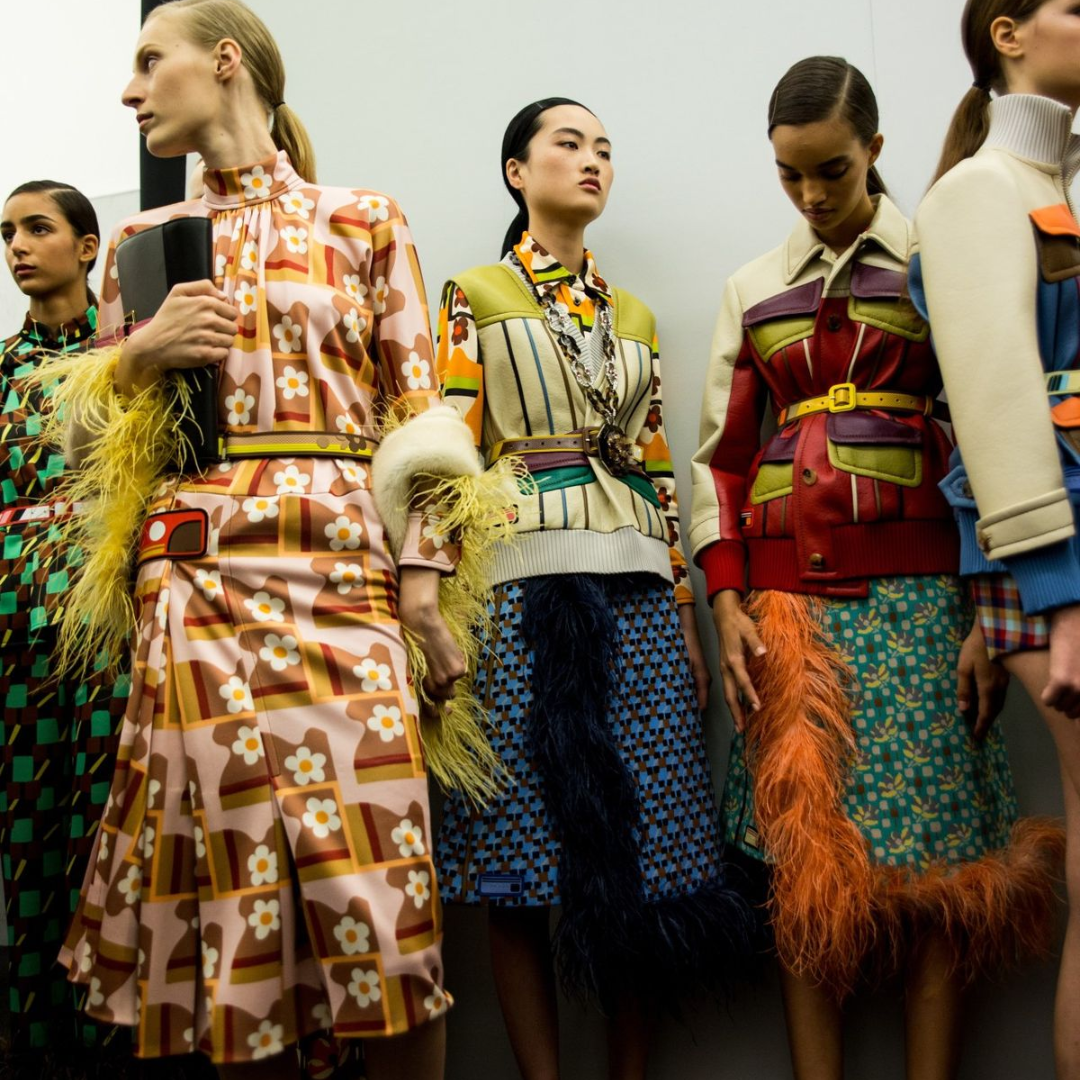
What is it exactly? Not simply ugly garments, but pieces that incorporate deliberately uncomfortable elements: colors that shouldn't work together but do, shapes that challenge the classic canon of femininity, and apparently kitsch details elevated by impeccable tailoring. Skirts with fifties tablecloth prints paired with rigorous military blazers. Footwear with clunky platforms that become cult objects. Bags with deliberately unglamorous shapes that transform into status symbols.
«What is considered ugly fascinates me much more than what is considered beautiful. The ugly is more creative.»
Miuccia Prada
The effect of this philosophy has been twofold. On one hand, it gave the cultured luxury audience a new visual language, a new grammar of elegance that does not depend on immediate approval. On the other, it built an extraordinarily solid brand loyalty: those who understand Prada do not abandon it easily, because they feel they share something deeper than a simple aesthetic preference with the brand.
It is no coincidence that Prada collections from the nineties and early two-thousands are today among the most sought-after on the international vintage market. Pieces that may have seemed deliberately awkward at the time appear surprisingly current today, almost prophetic.
Vintage Prada: why it is the most sensible choice of all
Let us get to the heart of it. Why choose a vintage or pre-owned Prada garment or accessory instead of buying it new? There are at least three good reasons, and none of them have to do with economic savings, although those exist and are significant.
1. The timeless philosophy is concrete, not a slogan
Prada has never chased seasonal trends as many other brands do. Its collections respond to an internal, almost self-referential logic, making them unusually resistant to aging. A nineties Prada bag does not "look like the nineties" in the dated sense of the term: it looks like Prada, which is a timeless category. This means that a piece purchased on the pre-owned market can be worn today without the slightest concession to vintage as a costume.
2. Construction quality guarantees longevity
As we have seen, Prada has always invested in top-tier materials and construction. An eighties Pocono nylon bag, if maintained correctly, is structurally identical to a new one. Footwear, coats, and knitwear age with a dignity that makes the pre-owned market unusually rich with pieces in excellent or near-new condition.
3. Accessing unrepeatable archive pieces
The Prada vintage market offers something that official boutiques cannot: access to the archive. Those botanical print midi skirts from Spring-Summer 2000. The black loafers from the nineties. The Cahier, Galleria, and early nylon Tote bags. Pieces that have made history and which today, on the resale market, represent both a stylistic and economic investment.
Prada is a unique case in fashion history because it has managed to build a consistent vision that spans generations, materials, trends, and cultural revolutions. From Milanese leather goods in 1913 to the most discussed runway shows of the last twenty years, the common thread has always been the same: the conviction that quality, in both materials and thought, is the only luxury that never disappoints.
Buying a vintage Prada piece means carrying a fragment of that history with you. Not as nostalgia, but as a conscious choice of something designed to last — through time, space, and style.
We have curated a selection of authentic, verified Prada pieces for you, ready to be worn today. Iconic bags, archive clothing, collectible footwear. You can explore it here or in our physical boutiques in Milan, Brera, Como, and Legnano.