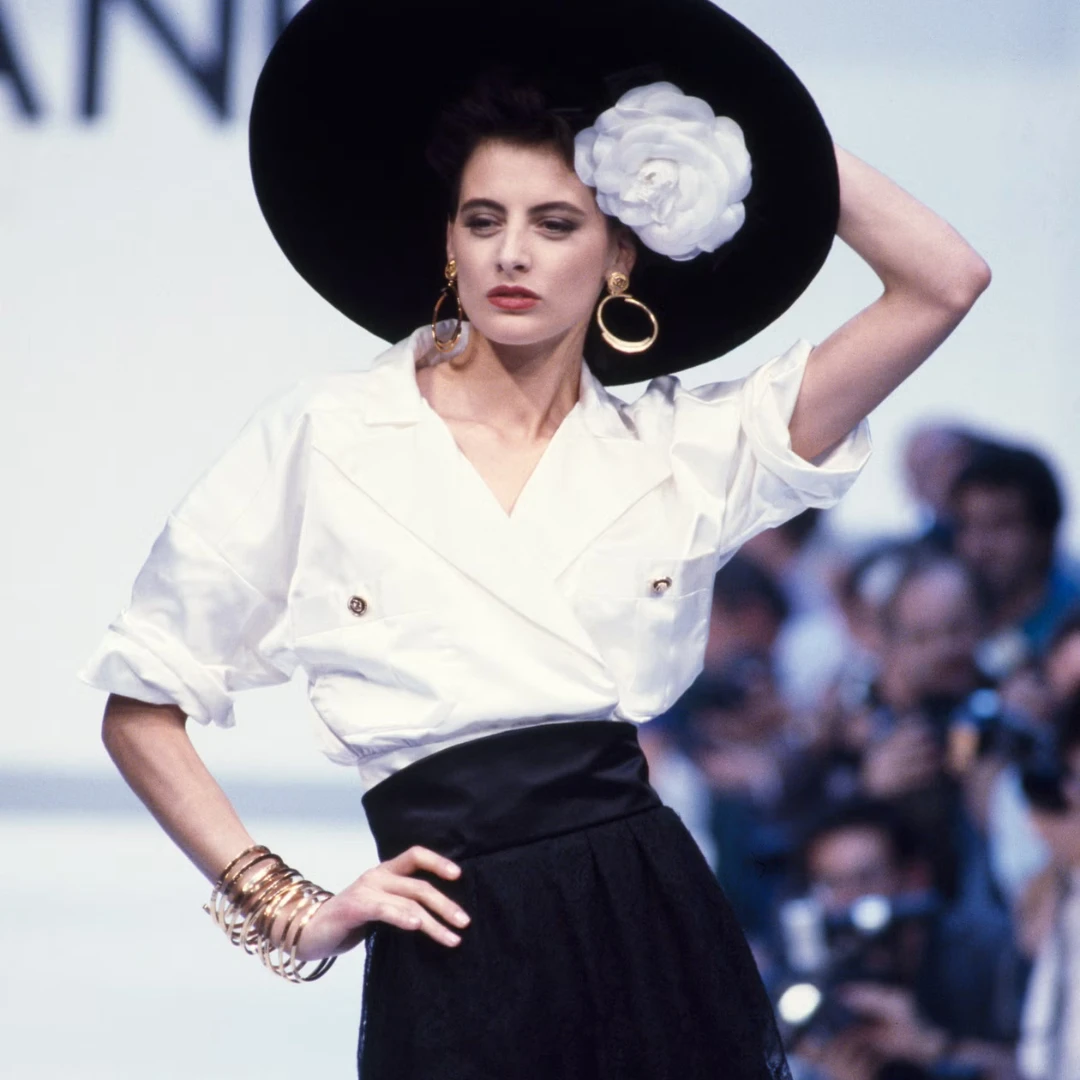
In twentieth-century fashion, no flower is more political than this one. The Chanel camellia is not a decorative accessory: it is a manifesto. White, scentless, and capable of blooming in the heart of winter without ever truly fading, the camellia has become over time a synonym for a precise, almost mathematical elegance—the very same that Gabrielle “Coco” Chanel claimed for herself and for the women she dressed.
To understand the history of this flower is to understand, ultimately, the very grammar of Chanel style.
Why the camellia: the origins of an obsession
The name camellia comes from the Jesuit botanist Georg Joseph Kamel, who first classified it in East Asia during the seventeenth century. It arrived in the West centuries later, conquering literary salons thanks to The Lady of the Camellias by Alexandre Dumas fils: it is said that a very young Gabrielle Chanel, struck by one of the novel's theatrical adaptations, developed a fascination that would never leave her.
But the real reason Coco chose this flower is, as often happens in her biography, a matter of character rather than sentiment. The camellia has no scent: for a woman about to launch her own revolutionary Chanel N°5, it was the only flower that could not “compete” with the fragrance. It is symmetrical, almost geometric in the arrangement of its petals, and resists the cold without wilting: a perfect metaphor for the woman Chanel wanted to dress—strong and composed even in the most difficult seasons.
1913, Étretat: the birth of a symbol
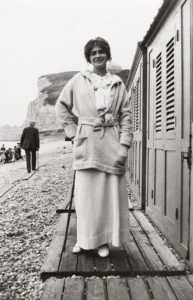
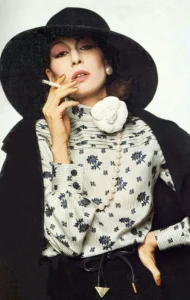
The date fashion historians cite as the founding act is 1913. On the Norman beach of Étretat, Gabrielle Chanel is photographed with a white camellia pinned to the waist of her sailor-style tunic. It is a minimal, almost casual gesture, but it marks the beginning of an iconography that spans more than a century.
From that moment on, the camellia ceased to be a simple garden flower and became a distinctive flourish: first embroidered on chiffon and organza, then transformed into a brooch, a jewel, a textile print, and a recurring motif on bags and décolletés. Coco wore it everywhere, had it designed on the walls of her private apartment at 31 rue Cambon, and transformed it into a signature as recognizable as tweed or the double C.
One flower, a thousand materials
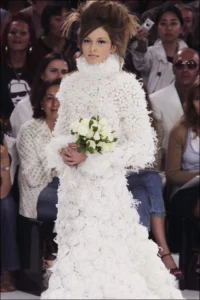
What makes the camellia a case study in design history is its extraordinary ability to reinvent itself while remaining always true to itself. Over the decades, the Maison has reproduced it in satin, feathers, velvet, coral, onyx, gold, and diamonds. Karl Lagerfeld, leading the house since 1983, made it a recurring element of his couture collections, even designing an entire wedding dress completely covered in white camellias in 2005.
There is also a more subtle, almost cryptographic reading that fashion history enthusiasts love to recall: the circular arrangement of the camellia's petals, when observed closely, evokes the shape of the two interlocking Cs that compose the Maison's logo: a happy coincidence or a conscious choice, it remains one of the small enigmas that make the Chanel brand so layered.
The camellia today: from couture code to pop icon
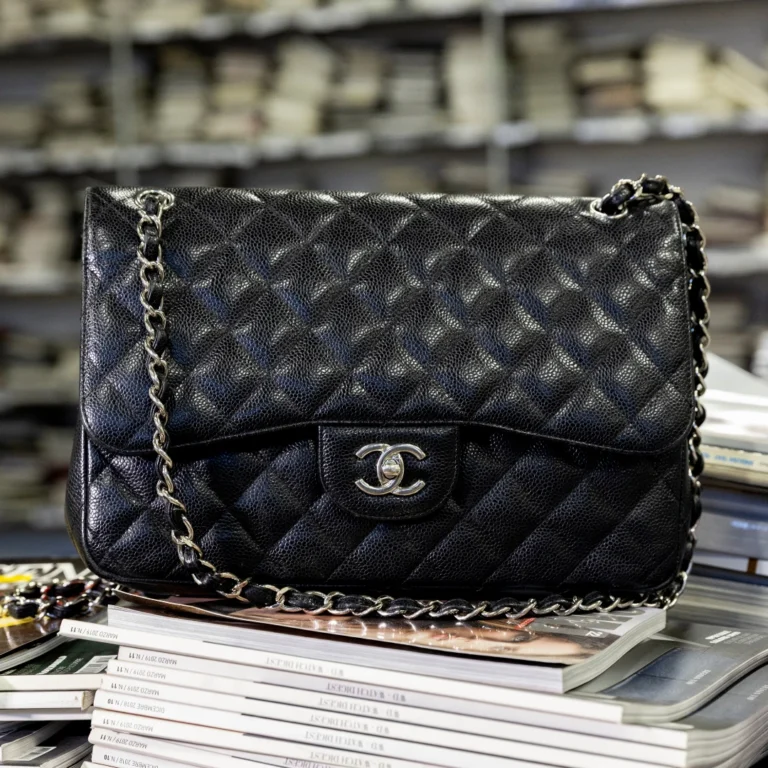
Under the creative direction of Virginie Viard first, and in the Maison's most recent seasons, the camellia continues to appear in prêt-à-porter, jewellery, and skincare lines, confirming itself as one of the few symbols capable of spanning eras, creative directors, and generations of clients without ever losing its meaning. It is a flower that, much like a tweed jacket or a 2.55 bag, never goes out of style: it is inherited, collected, and sought after.
The timeless charm of vintage Chanel
And this is precisely where the history of the camellia meets another great contemporary passion: that for luxury vintage fashion. A camellia brooch designed in the '80s, a pair of embroidered ballet flats from the Lagerfeld collections, a couture dress with a hand-embroidered floral motif: these are pieces that tell a precise moment in Chanel history, often unfindable in current boutiques, and therefore even more precious to those who love a style that does not follow seasons but moves through them.
Searching for a vintage Chanel piece with the camellia is not just a gesture of style: it is a way to possess an authentic fragment of this history, selected and verified for its authenticity.
Discover our selection of vintage Chanel. In our boutiques in Milano, Como and Legnano, you will find a curated selection of vintage and luxury second-hand Chanel pieces, from iconic camellia brooches to bags and archive pieces from different eras of the Maison, all authenticated and ready for a new life. Cannot visit the shop? The same selection is available on our e-commerce, with worldwide shipping.